What is a soil?
The soil
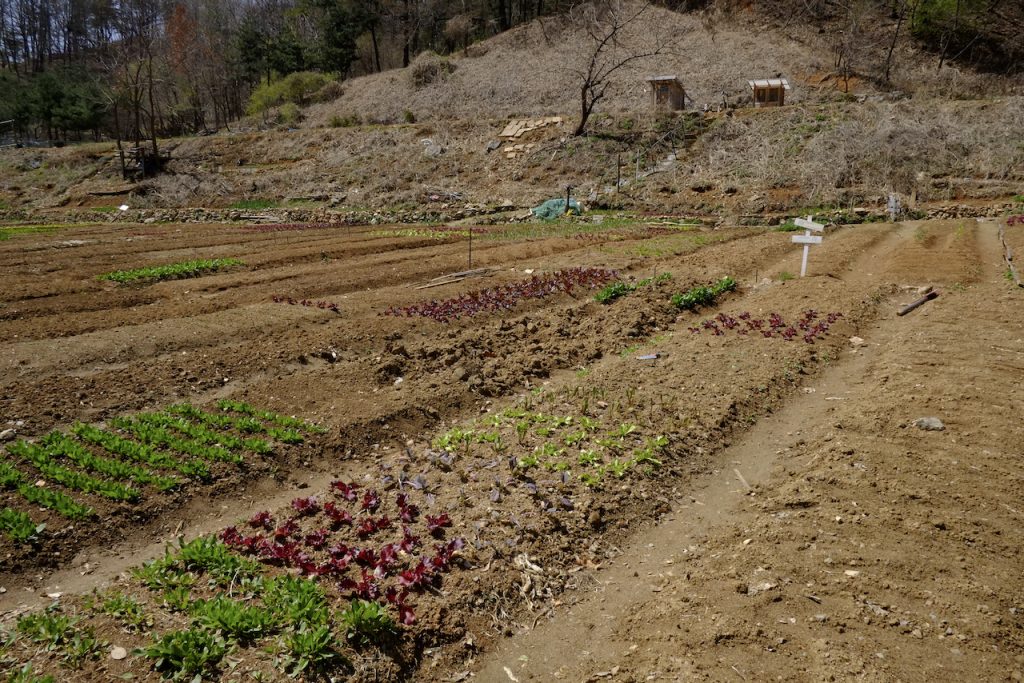
We tend to take the soil around us for granted, but it is more than just mud or dirt. All the food that we consume depends ultimately upon soil. Plants grow in soil and we either eat plants that grow directly in the soil or animals that have eaten plants.
As well as holding water and mineral nutrients that plants depend upon, soils act as an enormous filter for any water that passes through them often altering the chemistry of that water. Soils store and transfer heat affecting atmospheric temperature which in turn can affect the interactions between soil and atmospheric moisture.
A fertile soil has five main constituents:
- Inorganic mineral particles (derived from rock). Rock fragments themselves, sand, silt and clays.
- Organic components including organisms that live in the soil and dead and decaying parts of organisms – this creates humus.
- Both Inorganic and organic components of soil provide mineral nutrients.
- Water.
- Air.
These soil factors (in some texts they called edaphic factors) vary considerably on both a local and a geographical scale and affect the patterns of distribution of plant species and soil animals.
Soil Profiles
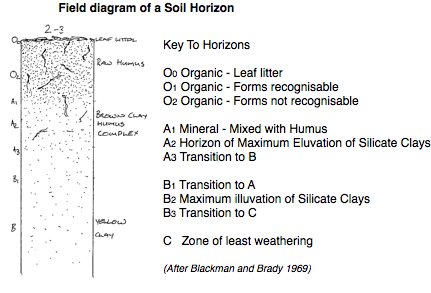
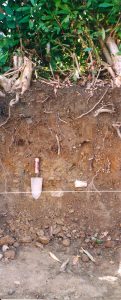
Vertical sections of a soil are called soil profiles. The arrangement of the various layers (horizons), Their thickness and composition at various depths provides a history of soil development.
O Horizon: Organic layer which may include newly added DOM at the top and organic matter in partially broken down states
A Horizon: Upper layer. This is where in many soils humus builds up. Humus forms from partially decomposed organic matter and often mixed with fine mineral particles. In normal conditions organic matter decomposes rapidly through the decomposer food web releasing soluble minerals that are then taken up by plant roots.
Humus that contains a high quanity of alkaline mineral is called mull humus where as humus low in alkaline minerals forms acidic mor humus. Waterlogging reduces the number of soil organisms which results in a build up of organic matter and can eventually lead to the formation of peat soils.
B Horizon: This is the layer where soluble minerals and organic matter tends to be deposited from the layer above. In particular clay and iron salts can be deposited in this horizon. The process that moves that moves these minerals down through the soil in solution is known as leaching. Soils that form in climates with high rainfall tend to be strongly leached.
C Horizon: This layers is mainly unaltered rock from which the soil forms.
Not all soils contain all three horizons, sometimes only two horizons can be distinguished while in other soils there may be not distinct layering.
Inputs, Outputs and Processes
Inorganic inputs into the soil system may come from:
- weathering of parent rock,
- deposition of minerals by water (rivers, lakes and floods)
- decomposition by chemical break down,
- precipitation of dissolved minerals in water,
- diffusion into the soil of air and gases,
- humidity – water vapour
- solar energy – affects soil temperatures
Soil formation
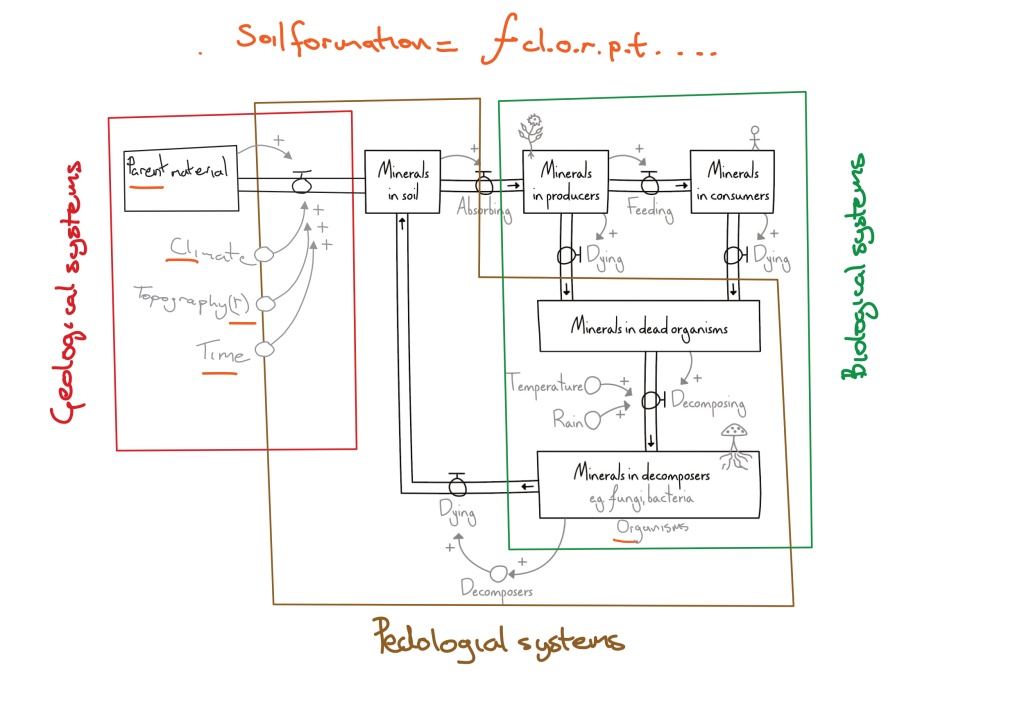
The soil that establishes in any one place depends on a complex set of soil forming factors. Pedologist Hans Jenny defined these factors in 1941. These factors are the climate in which the soil forms, the effect of organisms both in and on the soil, the shape of the land, the material that the mineral part of the soil is made from and time. Jenny summarised these as a functional equation:
S = ƒ cl. o. r. p. t. . . .
S = soil, cl = climate, o = organisms, r = relief (land shape, topography), p = parent material, t = time
Jenny left the equation open to add other factors such as human activity.
In this view soil is much more than the weathered remains of rock.
Climate affects the moisture content of soils, the movement of dissolved mineral and soil temperature.
Organisms add dead organic material, which in turn is broken down by soil organisms to release nutrients and carbon. Soil invertebrates create tunnels and mix soil particles. Roots penetrate the soil taking up both water and minerals.
Relief influences the stability of soils. Steep slopes tend to transport material down them, but also drain quickly. Shallow areas allow the deposition of material, but may become waterlogged. Altitude affects temperature and aspect can influences how much sunlight soils receive as well as creating rain shadows in mountain ranges.
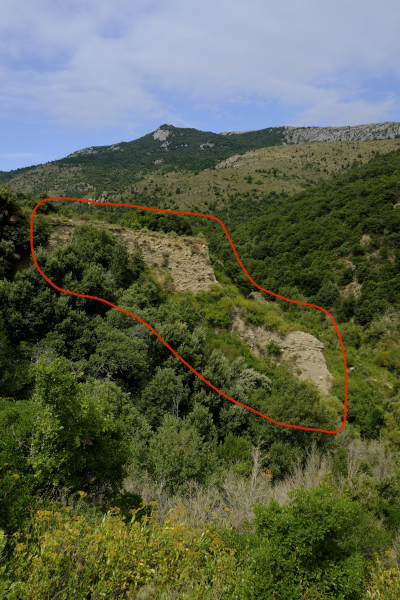
Parent material may be either from directly below the soil, bedrock, or may have originated through transport processes such as riverbed load, wind blown loess or glacial moraines. This gives the soil its basic chemical composition and physical structure, pH, available nutrients and grain size.
Time alters soils. It allows for weathering of mineral particles, movement and relocation of dissolved portions. Accumulation and decomposition of organic material and erosion and decomposition both require time.
Transformations and transfers:
Soil development involves transformations and transfers of materials. This incudes transfers by wind, water and animals. Transformations include chemical action and physical change.
Below is a diagram by Christian Moore-Anderson which summarises many of these inputs, processes (Transfers and Transformations) and outputs within Jenny’s equations.