
Environmental systems and societies guide
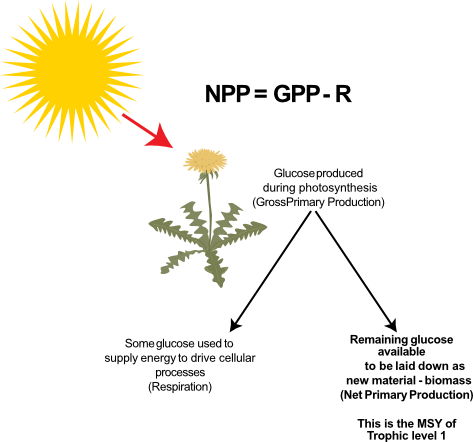
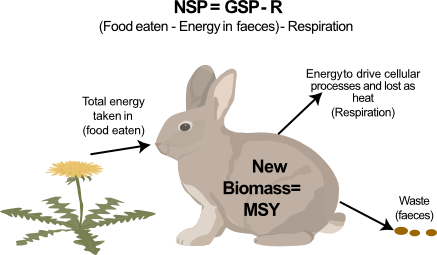
The Net Production of any organism or trophic level is the maximum sustainable yield (MSY) that can be harvested without diminishing the availability for the future.
Net Production for any trophic layer is the amount of energy laid down as new biomass.

Net Primary Production is the Maximum Sustainable Yield for Tropic Level 1 and Net Secondary Production is the Maximum Sustainable Yield for al other Tropic Level 2
HL Extension
The biomass produced as Net Primary Production the total quantity of carbon available for all other trophic levels in any ecosystem.
This is the same wether it is a natural ecosystem or an ecosystem altered by man such as agriculture or forestry (silviculture)
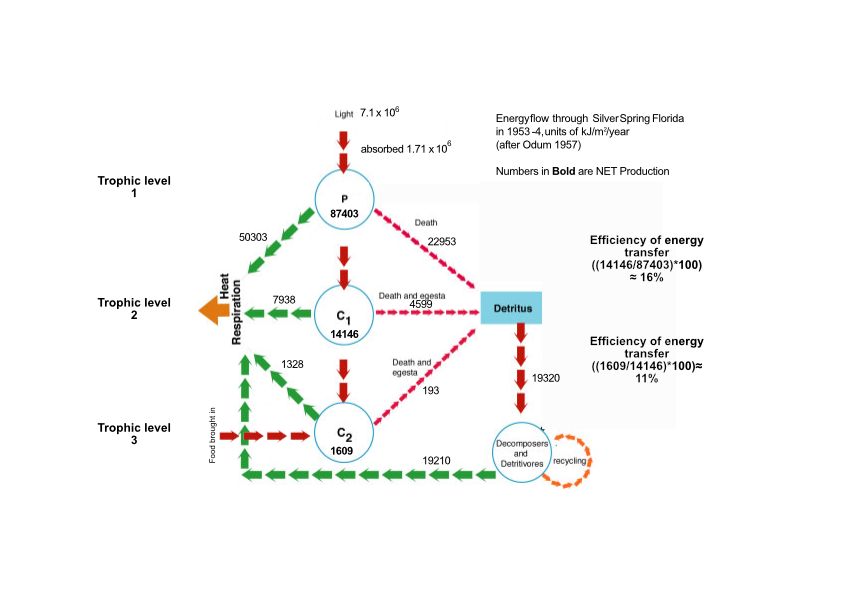
It is the maximum yield available for that ecosystem. As we have already seen as you move up the food chain the amount of energy transferred between trophic levels decreases because of entropy. So the Maximum Sustainable Yield is greatest within the Producer Trophic level.
In ecosystems managed by man Yield is an important consideration for profitability of the system.
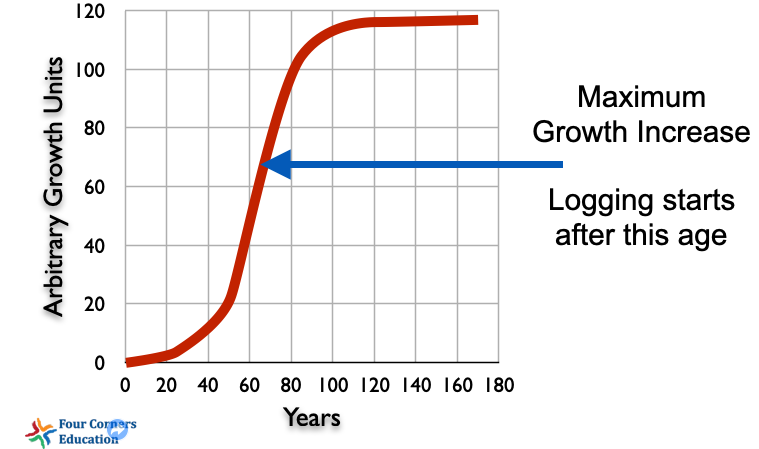
In the UK, Scots pine (Pinus sylvestris) are typically logged for commercial timber production between approximately 50 to 100 years old, depending on wood properties of wood which is required. This is
because the maximum mean annual volume increase in Scots pine occurs at around 65 years old. This is used to guide the logging cycle as it is the point where maximum rate of NPP occurs.

In agricultural systems food efficiency is easier to achieve if humans consume from lower trophic levels.
The Beef production illustrated below requires much more land for the same yield as grain production – most grain production now goes to feed intensively reared cattle. Think of the efficiency above in the Silversprings ecosystem. 16% efficiency between Trophic level 1 and 2 but only 11% between Trophic level 2 and 3. When humans eat vegetable matter they are feeding at Trophic level 2 but when they eat beef they are feeding at Trophic level 3.
Comparison of Agricultural Productivity of Wheat and Beef Systems in Europe
| Grain (Wheat) | Beef Cattle (average) | |
| Yield per Hectare | 3-5 tonnes | 400kg (usable carcass) |
| Energy per Hectare (gigajoules) | 31-148 GJ | 0.0112 GJ |
