
Howard Odum
In 1957 H. T. Odum published a pioneering work on hierarchy in and energy flow through an ecosystem.
Energy systems theory explores how energy flows through ecosystems, while hierarchy theory examines the organisation of ecosystems at different levels of complexity.
His central work was the concept of energy flow in ecosystems. Energy enters ecosystems from the sun, is captured by producers such as plants through photosynthesis, and then transferred through a series of organisms via feeding relationships.
Odum quantified flows of energy and matter as well as storage in the Silver Springs river system in the USA. He represented storage as boxes and flows as arrows where magnitude is represented by their size. This is a system model.
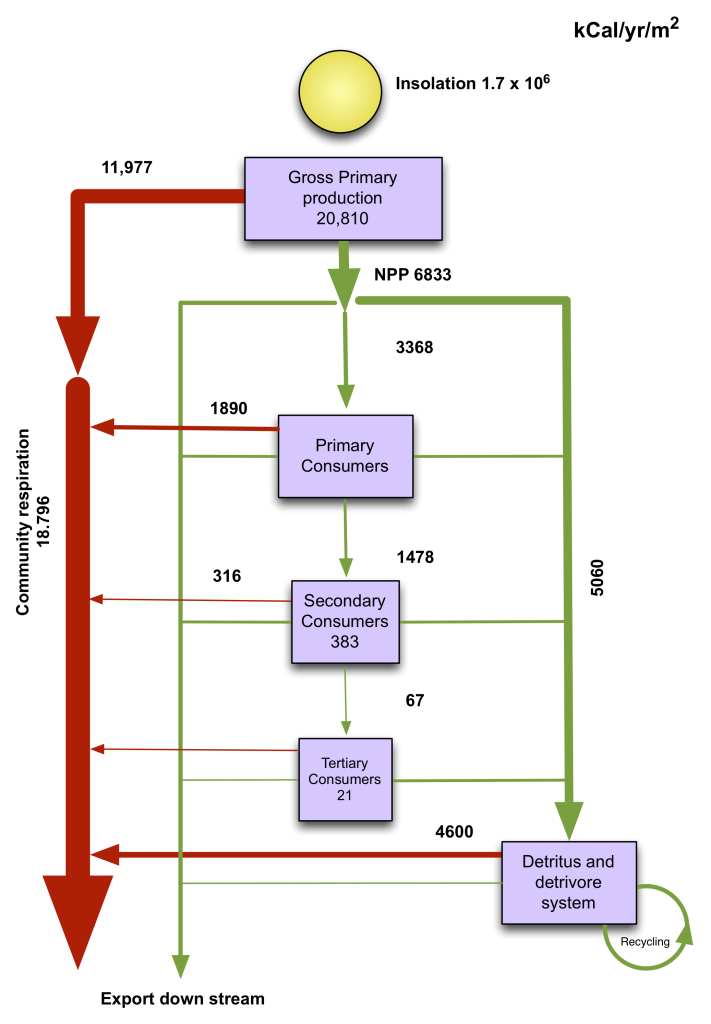
After, Odum, H. T. (1957), p61, Fig 7.
Models are simplifications of reality and can be used to help us understand a system better. They can also take may different forms, Odum’s flow diagram model while still used extensively is only one type of system model representation.

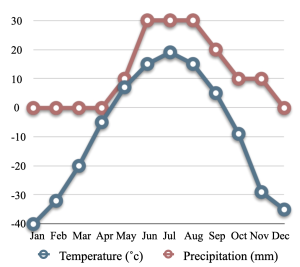
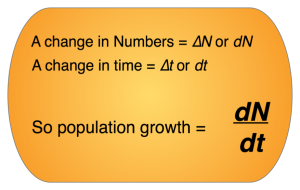
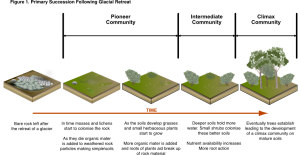
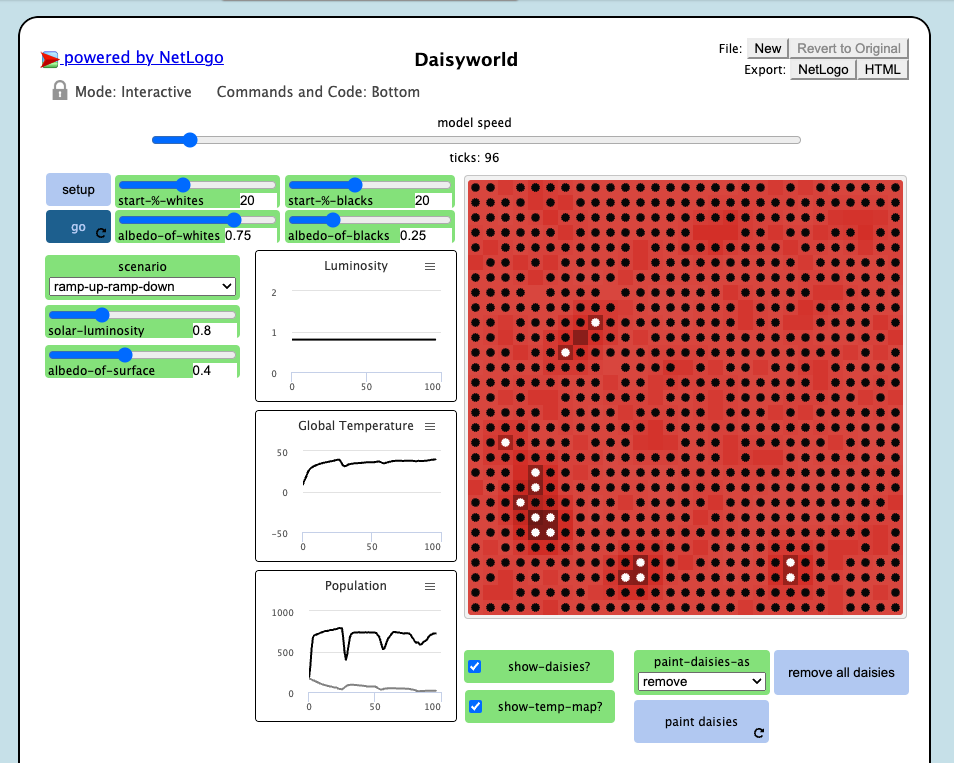
Systems can be represented through models as Graphs, Diagrams, Equations even as words as well as simulations. The daisy world model is represented through a simulation. The link below takes you to a live simulation of Daisy world1 using Net Logo2. You can alter the inputs and parameters of the world and examine how the daisy population changes over time.
Problems with models

Using models to represent complex systems, such as those we study within ESS, comes with inherent weaknesses that we need to be aware of:
- Simplification: Models often simplify complex systems to make them more manageable, but this can lead to important details being overlooked or misrepresented.
- Assumptions: Models are built on assumptions about how different components of a system interact, and if these assumptions are incorrect, the model’s predictions may be unreliable.
- Uncertainty: Complex systems are influenced by numerous variables, some of which may be unknown or difficult to quantify accurately, leading to uncertainty in model outputs.
- Bias: The creators of models may introduce unintentional biases based on their own perspectives or limitations in available data, potentially skewing results.
- Validation: Models need to be validated against real-world observations to ensure their accuracy, but this process can be challenging, particularly for long-term or large-scale predictions.
- Dynamic Nature: Complex systems are dynamic and constantly changing, which can make it difficult for models to accurately capture and predict their behaviour over time.
- Interconnectedness: Environmental and Societal systems are often interconnected in complex ways, and models may struggle to account for all relevant interactions, leading to oversimplified representations.
By understanding these weaknesses, we can start to critically evaluate any model and its limitations, leading to a more nuanced understanding of complex environmental and societal systems.
Work Cited
- Novak, M. and Wilensky, U. (2006). NetLogo Daisyworld model. http://ccl.northwestern.edu/netlogo/models/Daisyworld. Center for Connected Learning and Computer-Based Modeling, Northwestern University, Evanston, IL. ↩︎
- Wilensky, U. (1999). NetLogo. http://ccl.northwestern.edu/netlogo/. Center for Connected Learning and Computer-Based Modeling, Northwestern University, Evanston, IL. ↩︎