
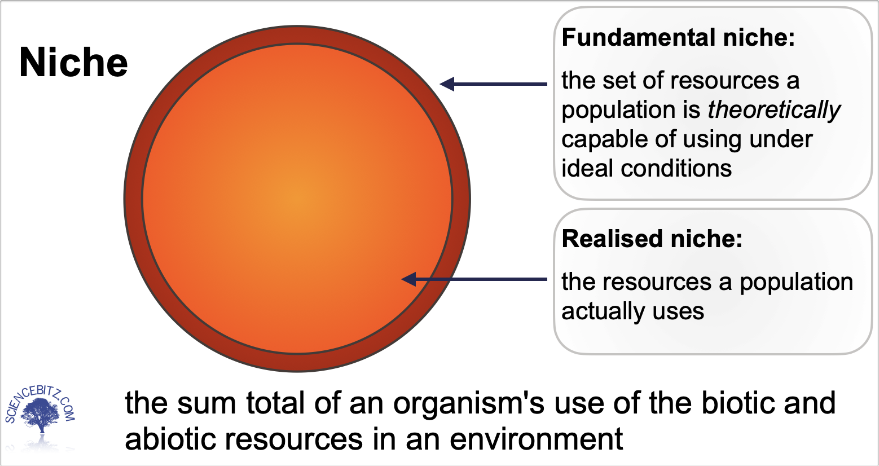
The fundamental niche describes the range of conditions and resources in which a species could survive and reproduce if there were no limiting factors. The realized niche of a species is the actual mode of existence, which results from its adaptations and competition with other species.

Classic Study of the Niche
A classic study of niché and competition between two species
Joseph Connell’s Barnacle experiment.
From observations of of two barnacle species on a rocky shore and their distribution up and down the shore, Connell noted:
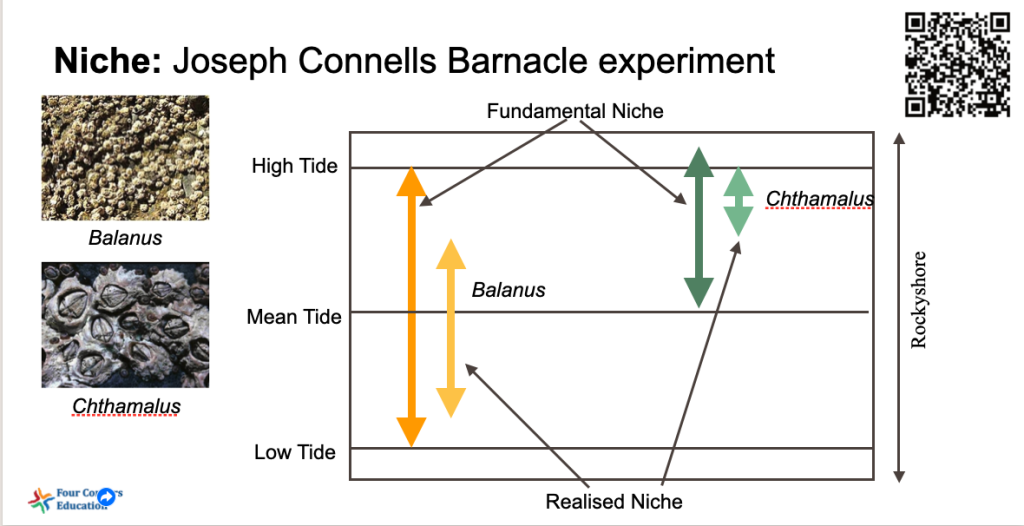
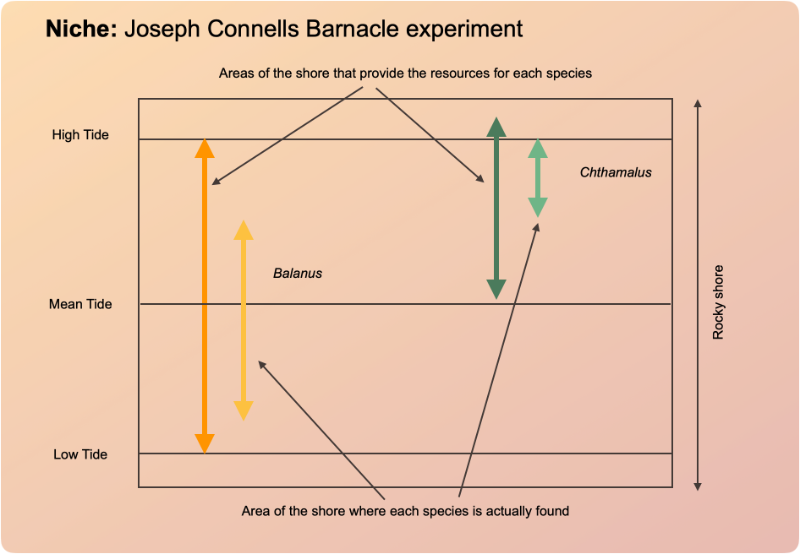
That one species Balanus mainly found on the lower shore between high and low tides
That the other species Chthamalus was mainly on the upper area
However the larvae of each species can swim anywhere on the the rocky shoreline so should be able to survive anywhere.
These observation led Connell to pose a Research Question (RQ): Why are they not found together?
Connell conducted a series of experiments:
EXPERIMENT ONE
He removed Chthamalus for the top of the shore but Balanus did not replace it. His conclusion was that Balanus need to be in the tidal area and could not survive the often dry periods between the highest tides
Balanus realised niche was the same as its fundamental niche.
EXPERIMENT TWO
He removed Balanus for the bottom of the shore and Chthamalus replaced it:
His conclusion was that Balanus outcompeted Chthamalus in the lower tidal area
Chathamalus has a smaller realised niche than its fundamental niche because of competition from Balanus.
What Connell had shown was that biotic interactions between individuals of different species can explain the actual conditions and resources (abiotic) in which a species exists as its realised niche.

So from this we can see that competition between two species can either reduce the size of both populations:
Or one species may totally out competes the other species.

This is the principle of Competitive Exclusion